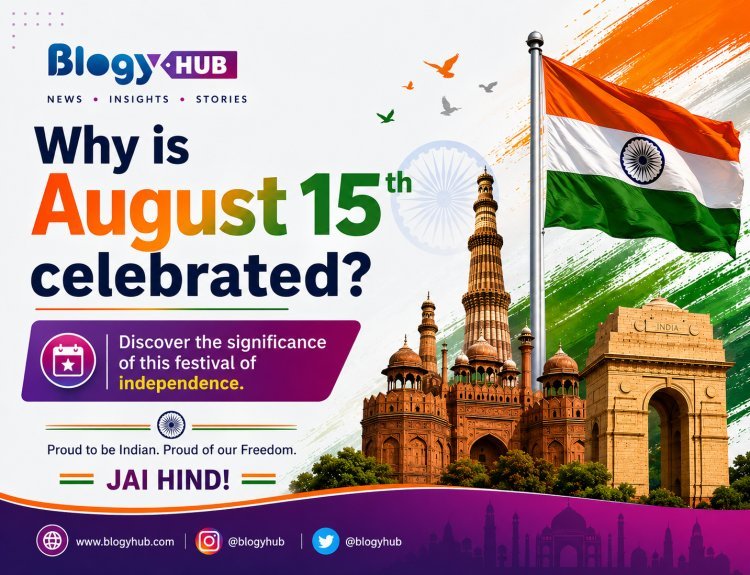
Why is August 15th celebrated? – Discover the significance of this festival of independence.
Why is August 15th celebrated? Learn about the history of India's independence, the significance of Independence Day, and the inspiring story behind it.
 Ankush Pandey
Introduction – The Historical Significance of August 15
- India's Journey to Independence
- The Beginning and End of the Freedom Struggle
History of August 15
- The Dawn of 1947 – A New India
- The Declaration of Independence and Its Impact
The Contribution of Freedom Fighters
- Mahatma Gandhi and the Satyagraha Movement
- Bhagat Singh, Chandrashekhar Azad and the Revolutionary Movement
Celebrating August 15th – How It's Celebrated
- Prime Minister's Address from the Red Fort
- The Tradition of Hoisting the National Flag
The Significance of August 15th – Today and Tomorrow
- A Symbol of Patriotism and Unity
- Inspiration for the New Generation
Introduction – The Historical Significance of August 15th
August 15th is the most important day in India's history. It marks the day when the country was liberated from years of slavery and breathed the air of freedom.
For over 200 years, India was under British rule. During this period, our ancestors fought many struggles, made sacrifices, and faced difficult circumstances.
August 15th (Independence Day 2025) is not just a date, but a symbol of our pride, sacrifice, and unity. On this day, independence is celebrated across the country, the tricolor is hoisted in schools, colleges, and government institutions, and people express their love for their country with patriotic songs and slogans.
In today's times, this day reminds us of our past and forces us to reflect on how we must protect our independence. Independence is not just a political issue; it is also an economic, social, and cultural responsibility.
India's Journey to Independence
India's journey to independence was long and arduous. British rule not only weakened India economically but also affected our culture and traditions. The First War of Independence of 1857, also known as India's First War of Independence, was the first major spark in this journey. Subsequent movements such as the Non-Cooperation Movement, the Civil Disobedience Movement, and the Quit India Movement forced the British to leave India.
Farmers, laborers, students, and women also played a significant role in this struggle. This was not just a fight of a few leaders, but of the entire nation. People from every caste, religion, and language joined in, proving that India is a true example of unity in diversity.
History of August 15, 1947
The morning of August 15, 1947, marked the beginning of a new era for India. At midnight, Pandit Jawaharlal Nehru declared independence in his "Tryst with Destiny" speech. On this day, two separate nations, India and Pakistan, came into existence.
On this day, British rule officially ended, and India became an independent nation. However, this independence was accompanied by the pain of Partition. Millions were displaced, and thousands lost their lives. Nevertheless, this day is considered one of the most glorious moments in Indian history.
Contribution of Freedom Fighters
If we are independent today, the credit goes to our freedom fighters.
Bhagat Singh, Chandrashekhar Azad, and the Revolutionary Movement
While Gandhiji adopted the path of non-violence, Bhagat Singh, Chandrashekhar Azad, and their comrades challenged British rule through revolutionary methods. They sacrificed their lives for the country's independence.
Celebration of August 15th – How It Is Celebrated (Independence Day)
On August 15th, there is an atmosphere of joy and patriotism throughout India.
Prime Minister's Address from the Red Fort
The Prime Minister hoists the national flag from the Red Fort in Delhi and addresses the nation. This tradition has been continuing since 1947.
The Tradition of Hoisting the National Flag
The tricolor is hoisted in schools, colleges, government, and private institutions across the country. People sing patriotic songs, organize cultural programs, and wish each other Independence Day.