Basic PHP Syntax ?
PHP content can be set in anyplace in the record. Beginning a PHP script with:
 Ankush Pandey
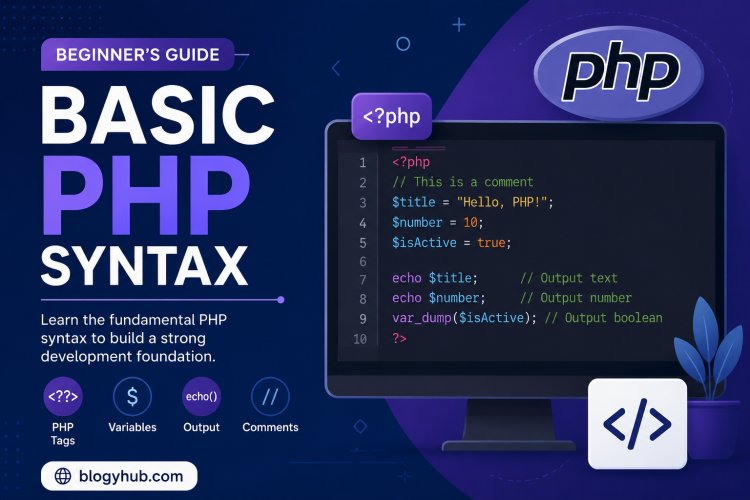
The plain HTML output is returned to the browser after a PHP script is run on the server. Anywhere in the document, a PHP script can be inserted. A PHP script ends with ?> and begins with
PHP files have a default extension of.php. PHP scripting code and a few HTML tags are typically found in a PHP file. Here is an example of a basic PHP file with a PHP script that outputs text on a webpage using the PHP echo function:
Example
A simple .php file with both HTML code and PHP code:
My first PHP page
Note: All PHP statements end with a semicolon (;).
PHP Case Sensitivity
Classes, functions, user-defined functions, and PHP keywords (such as if, else, and echo) are not case-sensitive. Both echo statements in the following example are permissible:
Example
ECHO is the same as echo:
Note: However; all variable names are case-sensitive!
Just the first statement in the example below will show the value of the $color variable! This is a result of treating $color and $COLOR as distinct variables:
Example
$COLOR is not same as $color:
Exercise?
A PHP script starts and ends with:
- <?
//PHP code
?>
//PHP code
?>
//PHP code
?php>