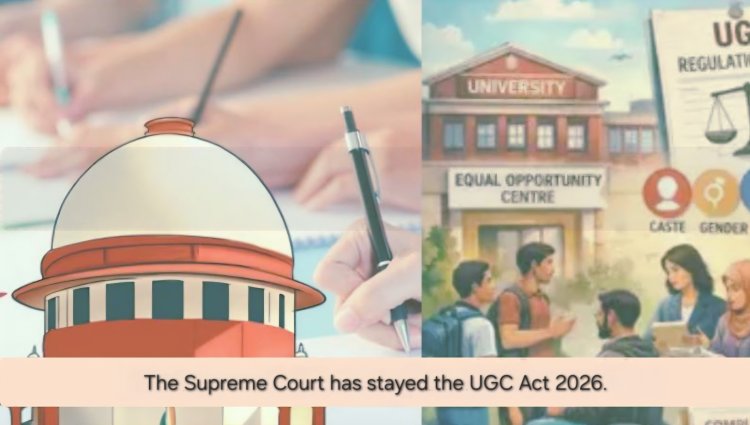
The Supreme Court has stayed the UGC regulations, citing the "possibility of misuse."
The Supreme Court has stayed the controversial UGC regulations, stating that the provisions are prima facie vague and could be misused.
 Ankush Pandey
The Supreme Court has stayed the controversial UGC regulations, stating that the provisions are prima facie vague and susceptible to misuse. The Supreme Court began hearing petitions challenging the new UGC regulations on Thursday. A Supreme Court bench comprising Chief Justice Surya Kant and Justice Joymalya Bagchi directed the central government to revise the rules, and their implementation has been stayed until then.
The petitions argued that the new UGC regulations interfere with the rights of states and the autonomy of universities. Concerns were raised particularly regarding the appointment process, administrative control, and academic decisions. The petitioners contended that since education falls under the Concurrent List, the unilateral implementation of rules by the UGC alone is against the spirit of the Constitution.
PM's "Big Thanks" After Trump's Tariff Cut "Unlocks Immense Opportunities".
Advocate Vineet Jindal had filed a petition challenging Section 3(c) of the regulations, which defines caste-based discrimination as discrimination against members of Scheduled Castes, Scheduled Tribes, and Other Backward Classes.
After hearing the initial arguments from all parties, the Supreme Court clarified that the new UGC regulations would not be implemented until a final decision is reached. The Court also sought a response from the central government and the UGC on the matter.
This decision has provided temporary relief to states and universities, and has also instilled hope among students and teachers that their concerns will be seriously considered. All eyes are now on the Supreme Court's final verdict, which will determine the future direction of the country's higher education system.
What did the Supreme Court say about the UGC regulations dispute?
The controversy surrounding the “Promotion of Equity in Higher Education Institutions Regulations, 2026,” implemented by the University Grants Commission (UGC), has now reached the Supreme Court. The Supreme Court, in no uncertain terms, stated that the new UGC regulations are prima facie vague and that the possibility of their misuse cannot be ruled out. The court made this observation during the preliminary hearing on the constitutional validity of the rules.
A bench comprising Chief Justice Surya Kant and Justice Joymalya Bagchi observed that the definition of discrimination is extremely broad, potentially bringing even routine academic decisions, disciplinary actions, and administrative steps within the purview of the regulations. According to the court, if the rules are not clear and balanced, they could disrupt the functioning of universities and destabilize the educational environment.
The Supreme Court also stated that the autonomy of higher education institutions and the rights of the states cannot be ignored. Education falls under the Concurrent List of the Constitution, and therefore, the unilateral implementation of rules by the UGC alone is not in line with the spirit of the federal structure. On this basis, the court directed the central government and the UGC to reconsider the regulations.
The court, in its interim order, clarified that the new UGC Regulations of 2026 would not be implemented until the final judgment is delivered, while the old UGC rules of 2012 would remain in effect. However, the Supreme Court, using its powers under Article 142, also ensured that the existing grievance redressal mechanism for marginalized sections would not be weakened.
Overall, the Supreme Court has attempted to strike a balance, acknowledging the principles of equality and social justice on the one hand, while also expressing serious concerns about the potential problems arising from ambiguous laws on the other. All eyes are now on the court's final decision, which will shape the direction of higher education policy in the country.
What are the UGC guidelines?
On January 13, 2026, the University Grants Commission (UGC) implemented a new regulation, the “Promotion of Equity in Higher Education Institutions Regulations, 2026.” This regulation applies to all universities and colleges in India and its primary objective is to prevent caste-based and other forms of discrimination in higher education institutions.
These regulations define caste-based discrimination as any unfair or biased treatment against Scheduled Castes (SC), Scheduled Tribes (ST), and Other Backward Classes (OBC). This provides explicit legal protection to OBCs and addresses a significant shortcoming in the previous draft framework.
Bank Holidays In Jan 2025 Banks Will Close for 15 Days on New Year's Day; Check Holiday Schedule
The new law/regulation implemented by the UGC in 2026 was considered a significant step towards ensuring equity, inclusion, and a discrimination-free environment in India's higher education system. It was primarily introduced to prevent discrimination in higher education institutions based on caste, religion, gender, language, region, disability, or any other ground.
What is the controversy related to the UGC regulations?
The “Promotion of Equity in Higher Education Institutions Regulations, 2026,” implemented by the University Grants Commission (UGC) in 2026, has become not only an academic or administrative issue in higher education institutions but also a subject of social and political controversy.
- The most significant controversy revolves around the broad and vague definition of discrimination. Critics argue that the rules define discrimination too broadly, potentially encompassing academic evaluations, disciplinary actions, or administrative decisions. This is raising concerns about creating a sense of insecurity among teachers and administrators.
- The second major controversy concerns false or malicious complaints. The lack of clear punitive provisions for false complaints in the rules is being criticized, raising fears of potential misuse of the grievance redressal mechanism.
Political controversy related to UGC's new rules
- Differences of opinion have also emerged among political parties regarding these regulations. Some political parties and organizations have described it as a necessary step towards social justice and the protection of marginalized communities, while other parties have called it politically motivated.
- Critics allege that these rules could further strengthen identity politics on university campuses and turn educational institutions into centers of ideological conflict. Supporters, however, argue that if measures for equality are not implemented due to fear of political repercussions, social injustice can never be eradicated.
- In some states, the regulations have also led to tensions between state governments and the central government over jurisdictional issues, thus linking the matter to the federal structure of the country.
After being disqualified as an MP, Rahul Gandhi was asked to leave his official bungalow.
What is UGC?
The University Grants Commission (UGC) is a premier statutory body in India that regulates, develops, and strengthens the country's higher education system. The first attempt to establish a national education system in India began with the Sargent Report of 1944, which recommended the formation of a University Grants Committee. The UGC was established in 1956 under the UGC Act, 1956. It functions under the Ministry of Education, Government of India.
- The University Grants Commission (UGC) is headquartered in New Delhi and comprises a chairperson, a vice-chairperson, and ten other members appointed by the Central Government.
- Its primary functions include allocating grants to universities, advising on higher education reforms, and promoting quality and standards in higher education.
- The main objective of the UGC is to ensure quality, equity, and standardization of education in universities and higher education institutions across India. The commission provides grants to universities, thereby promoting teaching, research, infrastructure development, and academic advancement. The UGC also determines which institutions are eligible to receive university status.
- A crucial role of the UGC is setting academic standards. It formulates regulations related to curriculum frameworks, teacher qualifications, research standards, examination systems, and degree recognition. It also conducts examinations such as the NET (National Eligibility Test), which sets the minimum eligibility criteria for teaching and research in higher education.
- In recent years, the UGC has implemented several reforms in line with the National Education Policy (NEP-2020), such as the Academic Bank of Credits (ABC), the Multiple Entry-Exit System, promotion of online and open learning, and regulations related to equity and inclusion in higher education institutions. These efforts aim to make education more flexible, inclusive, and student-centric.
'Seeta Haran hua to Raamaayan Huee'; What did RSS chief Mohan Bhagwat say on Kolkata rape case?
UGC Bill Postponement FAQs
Question 1. Why has the Supreme Court stayed the new UGC regulations?
The Supreme Court stated that the new UGC regulations are prima facie vague and susceptible to misuse. According to the court, these provisions could interfere with the autonomy of universities and the rights of the states, and therefore, they have been stayed until a final decision is reached.
Question 2. Which UGC regulation has the Supreme Court stayed?
The Supreme Court has temporarily stayed the “Promotion of Equity in Higher Education Institutions Regulations, 2026”. However, the older UGC Regulations of 2012 will remain in effect.
Question 3. What is the main controversy surrounding the new UGC regulations?
The main controversy revolves around the broad and vague definition of discrimination. Critics argue that this could bring academic decisions, appointment processes, and administrative actions under the purview of discrimination.
Question 4. Has the Supreme Court issued any directives to the central government?
Yes, the Supreme Court has directed the central government and the UGC to reconsider these regulations. The implementation of these regulations has been halted until then.
Question 5. Do the new UGC regulations provide legal protection to OBC, SC, and ST communities?
The new UGC regulations define caste-based discrimination as discrimination against SC, ST, and OBC communities, claiming to provide explicit legal protection to OBCs for the first time.
Question 6. What will be the impact of the Supreme Court's stay on the UGC New Rules on students and universities?
This decision provides temporary relief to universities and states. It also raises hopes among students and teachers that the concerns of all stakeholders will be seriously considered before a final decision is made.
Lok Sabha polls: PM Modi to speak at third public gathering in Kongu region; increased security